The operational
system
of record
for enterprise AI
One structured model of how your organization actually works, above the systems you already run.
Every organization is a set of silos
The ERP holds the transactions.
ERP
01 / 03
The document system holds the files.
Document system
02 / 03
Spreadsheets hold everything that never found a home.
Spreadsheets
03 / 03
Every department sees part of the same work.
Nobody sees the whole.
AI can read your systems. It cannot read your organization.
Without a shared operational model, agents do not know what the data means, how it relates, or what they can safely change.
80%
say AI improved their own productivity.
37%
see any EBIT impact.
Source: McKinsey, The state of AI in 2026, August 2026, n=1,719
We build the missing layer
We give them a shared spine.
One operational model above the systems already in place.
The same record people work from gives agents the context to act.
We do not replace systems that work.
Watch the silos become one model.
Transcript
Transcript
The middle layer is two layers.
One builds the operational model.
One becomes the place the organization works from.
01 / 04
Existing systems
ERP, documents, spreadsheets, APIs. They stay.
02 / 04
The operational model
How the organization actually works, in one structure.
03 / 04
The Workspace
Where people and agents work from it, every day.
04 / 04
Answers, KPIs, agents
What the organization sees, decides and acts on.
Together, they create the shared operational record.
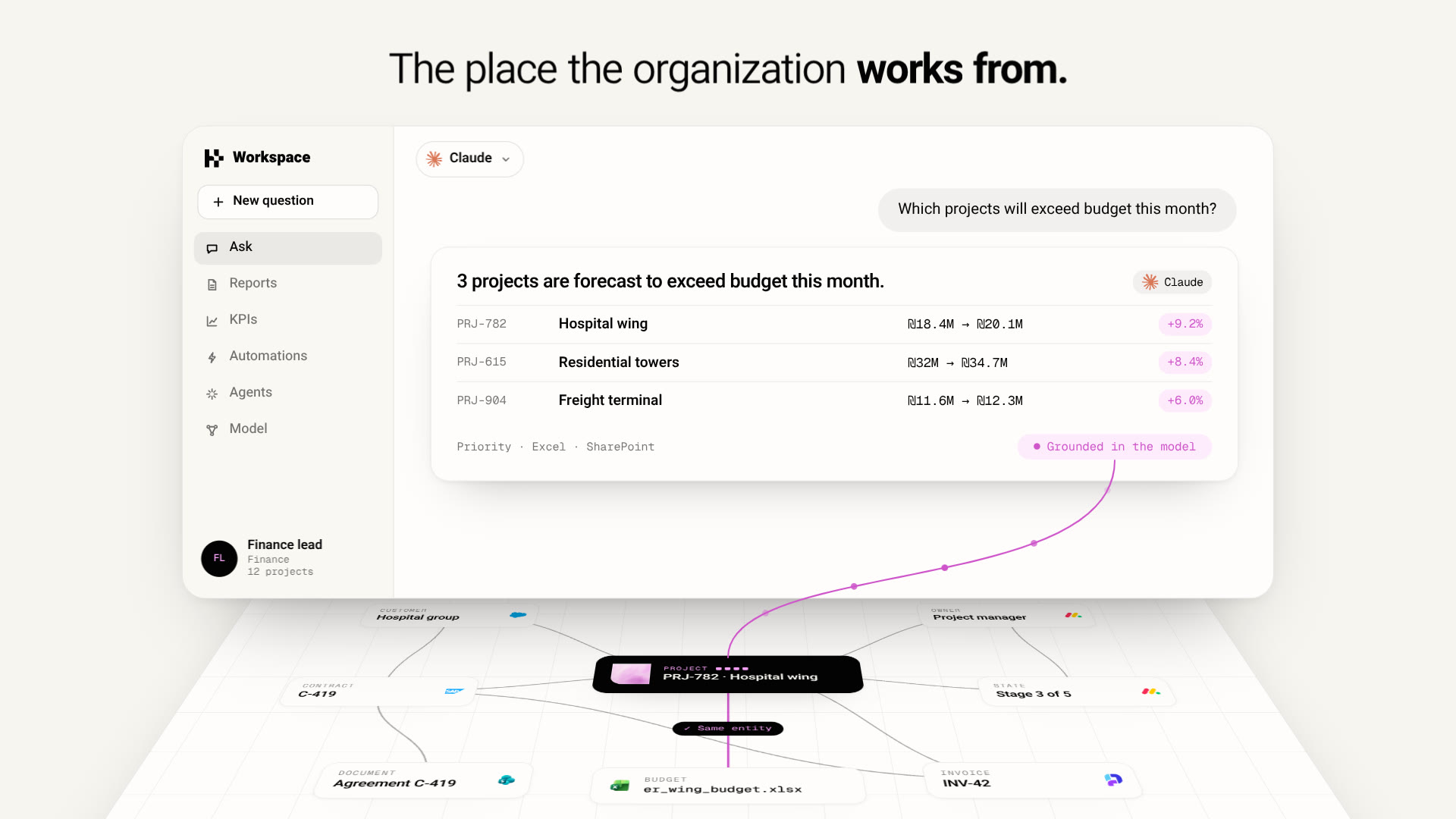
See the modelThe place the organization works from.
A workspace built around one operational model. One place to see what needs attention, ask a business question, see the context behind the answer, and turn it into work.
01 / 04Attention
What needs my attention today?
The operating picture is already organized around what needs attention: what is at risk, what is waiting on a decision, what changed.
Good morning
Needs your attention
- At riskPRJ-782 · Hospital wingForecast 9.2% over budgetERP · Spreadsheet
- Waiting on youChange order 14Approval requested by operationsWork management
- ChangedInvoice INV-42Updated from the ERP overnightERP
- At risk
- 3
- projects
- Expected overrun
- ₪5.1M
- this month
- On budget
- 9 of 12
- projects
02 / 04Question
Ask the organization, not a database.
A real business question in plain language, answered from the operational reality of the organization, not from whichever system was opened first.
Which projects will exceed budget this month?
3 projects are forecast to exceed budget this month.
- PRJ-782Hospital wing₪18.4M to ₪20.1M+9.2%
- PRJ-615Residential towers₪32M to ₪34.7M+8.4%
- PRJ-904Freight terminal₪11.6M to ₪12.3M+6.0%
ERP · Spreadsheet · Documents
Grounded in the model
03 / 04Trust
See the context behind the answer.
Where it came from, what it relates to, what state it is in, and the evidence and authority behind it.
3 projects are forecast to exceed budget this month.
- PRJ-782Hospital wing₪18.4M to ₪20.1M+9.2%
ERP · Spreadsheet · Documents
Grounded in the model
Why this answer holds
PRJ-782 · Hospital wing
- Sources
- ERP, budget spreadsheet, contract documents
- State
- Stage 3 of 5
- Related records
- Contract C-419, budget file, invoice INV-42
- Decided by
- Project controls
Proposed: the budget spreadsheet belongs to PRJ-782
Same customer and same site, but no project ID in the file.
Confirmed by project controls
Decision recorded
AI proposes. Evidence supports. Authority decides.
04 / 04Work
Turn an answer into work.
A report, a KPI, the decision context and a follow-up a person approved: something the organization can work from.
Report
Budget risk
This month
Pinned to KPIs
- projects at risk
- 3
- expected overrun
- ₪5.1M
- average overrun
- 7.9%
Agent
Approved
Create 3 review tasks
One per project owner, from 7 invoices and the project contracts
- Review budget · PRJ-782Project manager
- Review budget · PRJ-615Site lead
- Review budget · PRJ-904Engineering lead
3 tasks created · logged
Approved by the finance lead · 14:02 · audit trail
Built for organizations with an operational core
Complex work. Multiple departments. Systems that already run the business.
Engineering and construction. Infrastructure and energy. Real estate. Logistics. Manufacturing. Professional services. Retail.